
Wake Word Detection
An always-on listener that wakes a device when it hears its name, without streaming the microphone anywhere. Our 14,818-parameter network listens for one word in every second of audio. We trained and tested it on real recordings from Google’s Speech Commands dataset, and tested it only on voices it never heard in training.
- of wake words caught from voices it never heard, at under 1% false triggers
- 95%
- parameters in the whole network
- 14,818
- of flash, as 8-bit integers
- 21 KB
- of wake words caught on hours of continuous speech, at 6–8 false wake-ups an hour
- ~90%
Where it's used
Listening all the time, on almost no power
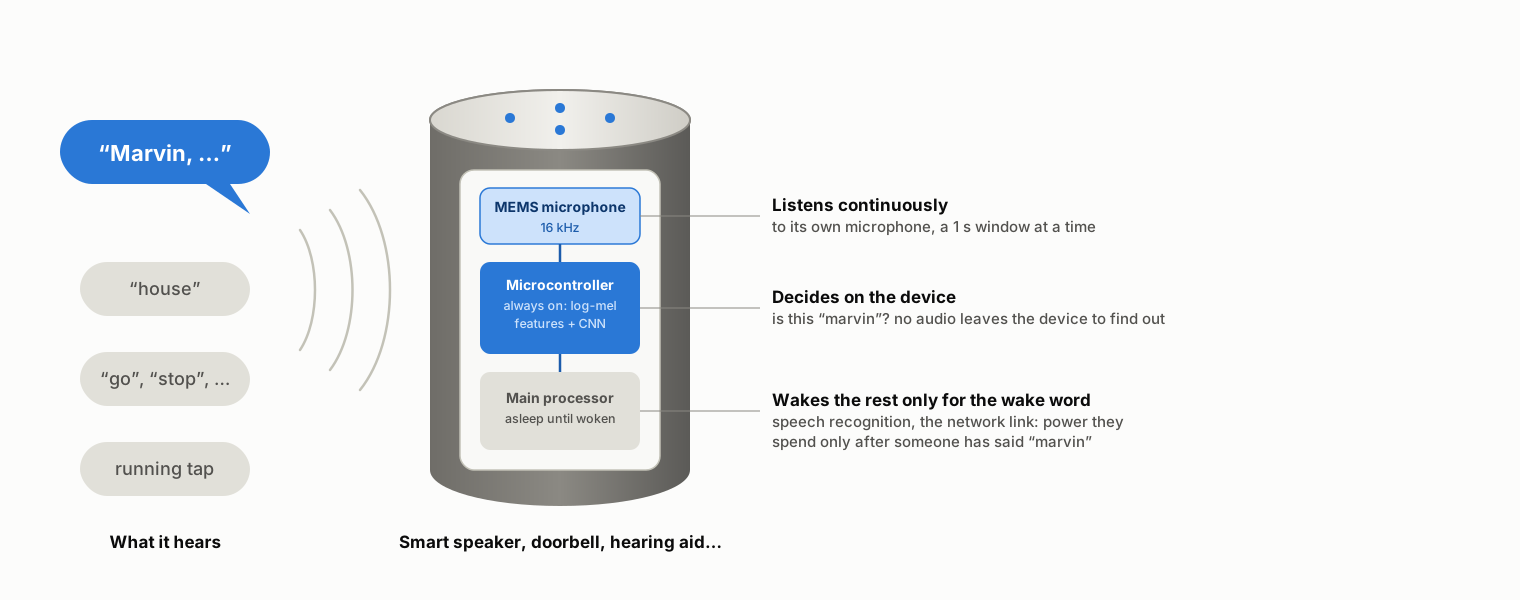
A doorbell, a smart speaker or a hearing aid that responds to its name needs something listening all the time. Streaming the microphone to a server costs bandwidth, power and privacy, and keeping a full speech recognizer awake drains the battery.
A wake-word detector gets around both. It’s a small model on a low-power processor that checks the last second of audio for one word, and wakes the rest of the system only when it hears it.
- A doorbell that answers to its name
- A smart speaker that wakes only when it’s called
- A hearing aid that responds when it hears its name
- No audio has to leave the device to listen for the word
The data
Real voices, real recordings
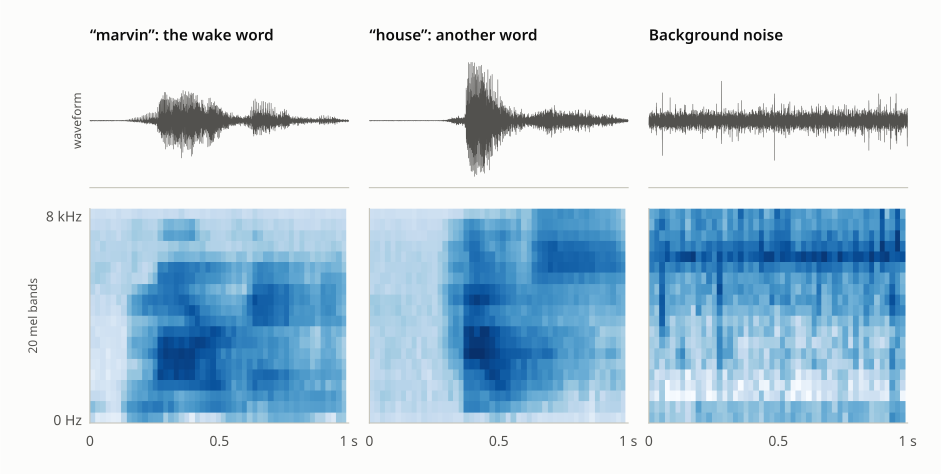
We used Google’s Speech Commands dataset: one-second clips of single spoken words from thousands of people, recorded on their own devices. The wake word is “marvin”. The network learns from 1,710 clips of it, set against more than 9,000 clips of other words and background noise, so it learns to stay quiet through both.
We split the data by speaker, using the dataset’s own lists, so every voice in the test set is one the network has never heard. That is what a product shipped to new users faces.
The wake word is just a setting. Training for a different word is a rerun, not a rewrite.
- Training · 38,344 clips
- what the network learns from: whole clips, each “marvin” also shifted a little in time, and one-second windows cut from runs of words, the way a listener hears them
- Validation · 10,020 clips
- checked after each round of training, and used to set the decision point
- Test · 11,048 clips
- 195 “marvin” clips and 10,853 others, kept aside until the very end. The scores below come from these.
How we built it
Sound in, one decision out
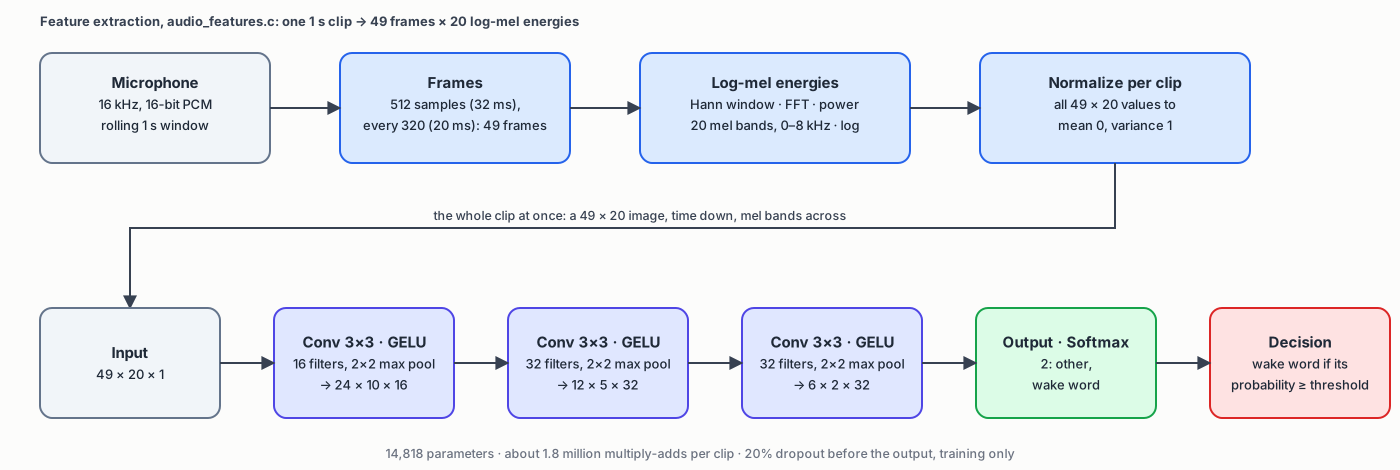
Two pieces work together. The first turns each second of audio into 49 short frames of 20 sound-energy bands, the same first step full speech recognizers use, and it runs identically on the device against the live microphone. The second is a small convolutional network that reads all 49 frames at once, as a picture of the second, and decides whether the clip was the wake word.
- 01
Frame
32 ms windows, every 20 ms: 49 per second
- 02
Transform
a 512-point FFT of each window
- 03
Bands
20 mel bands from 0 to 8 kHz, then the log of each
- 04
Normalize
every clip scaled the same way, whatever its volume
Loud or quiet, it hears the same thing. Real recordings vary enormously in volume and microphone quality. Each clip is normalized before the network sees it, which takes those differences out of the picture.
Results
95% of wake words, from voices it had never heard
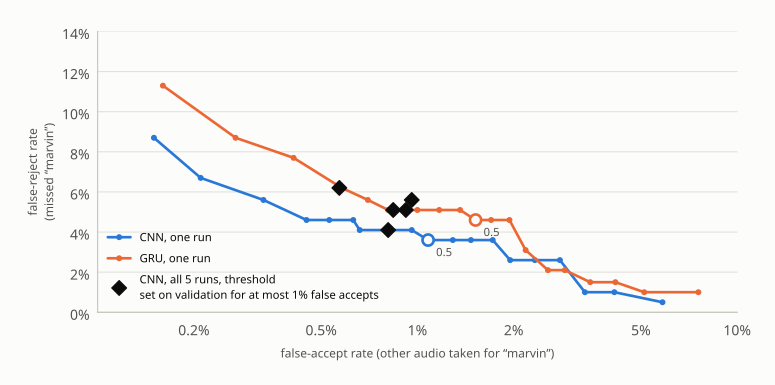
We trained the network five times and tested every run on the same 11,048 clips from speakers it never heard in training: 195 of them “marvin”, and 10,853 other words and background noise. With the decision point set for one false trigger in a hundred clips, every run caught between 93.8% and 95.9% of the wake words.
Tuned to your product
Every listener balances two kinds of mistake: missing the wake word, and waking up when it shouldn’t. Raising the decision point trades one for the other, and each product wants that balance somewhere different. A doorbell can afford the odd false wake-up, and a device that starts recording when it wakes can’t.
We set the decision point on a separate set of 10,000 clips, so it lands where you need it and stays there on new voices. A recurrent network a third its size, listening frame by frame, comes close: at the same setting it misses about 9% of wake words, against 5%.
Tested the way it listens
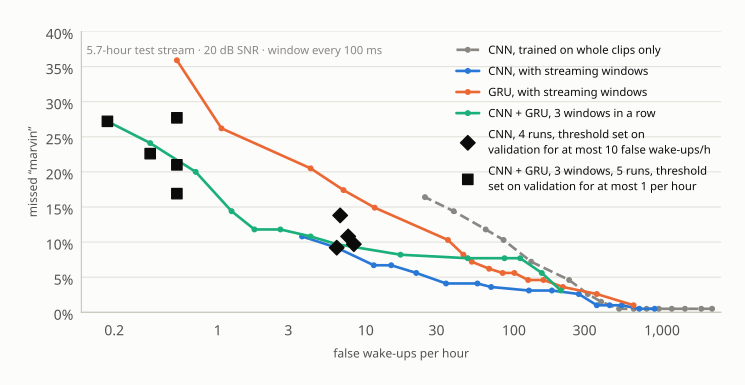
A device never hears neat one-second clips. So we also laid every test clip end to end into a 5.7-hour stream over background noise and slid the detector along it ten times a second, the way it runs in a product. It caught about 90% of the wake words, waking by mistake 6 to 8 times an hour.
Getting there took training on windows cut from runs of words, not just whole clips. The same network trained on clips alone scored almost as well per clip, and on the stream it woke by mistake dozens to hundreds of times an hour. A test that only uses clips would never have shown it.
A second check cuts the false wake-ups further: the device wakes only when a small recurrent network agrees, three windows in a row. That brought every run under one false wake-up an hour on the stream, while still catching about four wake words in five.
On the device
An always-on listener on a microcontroller
On the device, the same feature code runs against the microphone buffer and our library runs the network. Each second of audio takes 49 small FFTs and about 1.8 million multiply-adds, and a live listener slides that one-second window along the stream.
Our tools convert a trained model to 8-bit integers, with no measurable loss of accuracy, and to a format that runs straight out of flash: 21 KB in all. Where RAM is tighter, a smaller layout fits in 21 KiB, at the cost of missing more wake words.
- microphone audio, read a second at a time
- 16 kHz
- multiply-adds for each second of audio the network checks
- ~1.8M
- of flash as 8-bit integers, with no loss of accuracy
- 21 KB
- of RAM, which a 128 KiB microcontroller fits
- 78 KiB
Want this in your product?
We build embedded AI like this into medical and industrial devices, from the sensors and firmware to the network running on the chip. Tell us what yours needs to recognize.
Founded in 2008 · Hudson, Ohio · info@coledd.com